
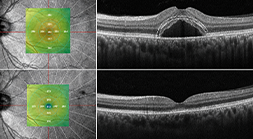


Aim: To evaluate the anatomical and functional outcomes of titrated-fluence-based, transfoveal subthreshold micropulse laser in patients with acute and chronic central serous chorioretinopathy (CSC).
Materials and Methods: Secondary data from patients with acute or chronic CSC treated between June 2021 and December 2024 were analyzed. All patients underwent transfoveal 577-nm subthreshold micropulse titrated-fluence-based laser. Optical coherence tomography (OCT) was performed at baseline, 4 weeks post-treatment, and at 6 months. The primary outcome was subretinal fluid (SRF) resolution after the first laser session. Secondary outcomes included best-corrected visual acuity (BCVA), final SRF resolution rate, recurrence, and treatment-related adverse effects.
Results: Twenty eyes of 18 patients were included. Median fluence ranged from 16.98–33.95 J/cm² (median 22.64 J/cm²), with a median number of 343 spots (206–568 interquartile range). Complete SRF resolution after the first session occurred in 75% of eyes; final resorption was achieved in 80% with a statistically significant difference between the acute and chronic groups at 6 months (p = 0.007). Median BCVA improved from 0.3 logMAR at baseline to 0.2 logMAR at 4 weeks and remained stable at 0.2 logMAR at the final follow-up (p = 0.027). No adverse effects were observed.
Conclusion: Transfoveal subthreshold micropulse laser appears to be a safe and effective treatment modality for acute and chronic CSC. Fluence titration may contribute to improved clinical outcomes and may assist in optimizing treatment parameters.