
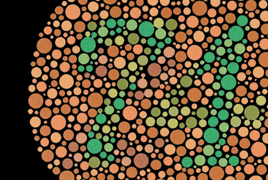


Our aim was to develop quick and exact instrument for examination of color vision defects (CVD). We used Lanthony saturated and desaturated test. Data were evaluated according the Vingrys and King-Smith study. We had together 123 eyes of 86 patients. From all subjects we received these average values: AA 44.32 (min -87.13, max 80.64), TES 13.36 (min 8.84, max 30.30), SI 1.97 (min 1.22, max 5.69) and CI 1.66 (min 1.0, max 3.94). At the base of counting algorithm and average values form saturated and desaturated test we revealed 25 (29 %) patients with CVD. Twelve patients (14 %) classified as CVD+ had dichromacy and all had inborn CVD. Eight patients (9 %) from this group had deutranopia and four patient (5 %) protanopia. Anomaly trichromacy we revealed in thirteen patients (15 %). Eight (9 %) of these patients had inborn CVD. Six (7 %) of these patients had protanomalia, one (1 %) had deuteranomalia and one tritanomalia. We established and specified TES, CI and SI critical values, which was used to dividing
patients into specific groups.
- The Effect of Toric Multifocal Lens Rotation on Visual Quality
- Refractive Surgery in Children with Myopic Anisometropia and Amblyopia in Comparison with Conventional Treatment by Contact Lenses
- The Effect of Cataract Surgery on the Reproducibility and Outcome of Optical Coherence Tomography Measurements of Macular and Retinal Nerve Fibre Layer Thickness
- Quantitative Colour Vision Defect Evaluation – Lanthony Test and its Modified Interpretation
- The Current Possibilities of Ophthalmological Diagnosis and Co-operation between Ophthalmologists and Neurologists for Patients with Idiopathic Intracranial Hypertension
- Pharmacological Tests for Horner Syndrome Case Report
- Punctate Inner Choroidopathy